
The Biggest Trend I See With Professionals Who Add Visual Facilitation to Their Work

(Spoiler: They’re the Ones Getting Promoted)
Why visual thinking is becoming a fast track to leadership growth inside organizations.
After two decades of working inside corporate environments — supporting teams at Google, Disney, Mars, NASA, Coca-Cola, and dozens more — I’ve noticed a pattern that’s too consistent to ignore:
The people who learn Visual Facilitation are often the ones who get promoted.
It’s not because they become “the person who can draw.”
It’s because they become the person who can do something far more valuable:
They create clarity.
They elevate conversations.
They help teams move forward faster.
And in today’s workplace, clarity is leadership.
Here’s why Visual Facilitation has become one of the most powerful accelerators for professional advancement.
1️⃣ They Become the Person Who Can Simplify Complexity
Every organization is dealing with:
-
competing priorities
-
rapid change
-
misalignment
-
information overload
Most meetings leave people with more questions, not fewer.
But the person who can sketch the idea, map the process, or make the strategy visible becomes the one everyone turns to when things get messy.
Visual thinkers quickly develop a reputation for:
✔ clarity
✔ structure
✔ insight
✔ calm in chaos
That alone makes them invaluable — and highly promotable.
2️⃣ They Stand Out in Meetings (For the Right Reasons)
Many talented professionals struggle to get noticed, even when they have strong ideas.
Visual Facilitation changes that.
When you can:
-
draw a framework on the whiteboard,
-
capture the conversation in real time,
-
illustrate a team’s thinking,
-
turn a confusing discussion into a clear next step…
You immediately shift from participant to leader.
People remember the person who made the meeting productive.
Senior leaders notice the person who helped the room think better.
3️⃣ They Become Natural Influencers Across the Organization
Visuals cross boundaries.
When someone starts using visual tools, suddenly:
-
project managers ask for their help
-
executives request them for strategic sessions
-
HR wants them for culture work
-
innovation wants them for brainstorming
-
training wants them to support learning
They become the connective thread across teams — a role that naturally leads to greater responsibility.
Visibility + impact = promotion.
4️⃣ They Demonstrate Leadership Without Needing the Title First
Here’s the secret most people don’t realize:
Visual Facilitation isn’t just a communication skill —
it’s a leadership behavior.
It shows you can:
-
guide a group
-
organize thinking
-
focus the conversation
-
support decision-making
-
move people toward action
When you do this consistently, people start treating you like a leader long before your job title changes.
By the time the promotion discussion happens, the only question is:
“Why didn’t we give them this role sooner?”
5️⃣ They Help the Organization Save Time — the Most Valuable Currency
Companies promote people who increase efficiency, reduce frustration, and help teams move faster.
Visual thinkers do all of those things.
A single visual map can:
-
end weeks of back-and-forth
-
align cross-functional teams
-
uncover gaps early
-
prevent mistakes
-
speed up implementation
When leadership sees that you reduce friction and accelerate clarity, you become someone they want in bigger rooms.
So Yes… The Spoiler Is True
The biggest trend I’ve seen?
Professionals who learn Visual Facilitation consistently rise.
Not because they draw.
But because they lead.
And in 2026, visual leadership skills are going to set the next wave of emerging leaders apart.
Want to Add This Skill to Your Leadership Toolkit?
If you want to:
-
communicate more clearly
-
stand out in meetings
-
support team alignment
-
lead strategic conversations
-
accelerate your career growth
…Visual Facilitation may be the most important skill you add this year.
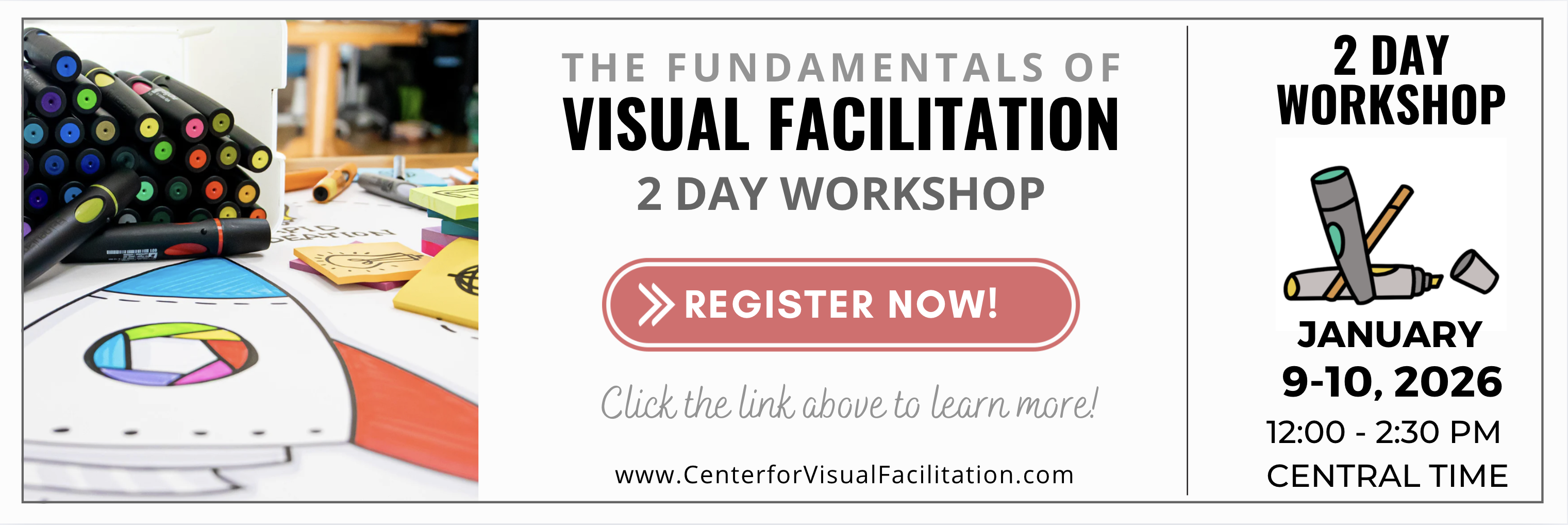
Fundamentals of Visual Facilitation
📅 January 9–10
🎨 Live Virtual Workshop
🧰 Build the visual toolkit used by leaders inside top global organizations
Join the Center for Visual Facilitation Community today and unlock a world of possibilities for your visual facilitation journey.
Connect with like-minded professionals, access exclusive resources, and embark on a visual adventure that will elevate your skills and expand your horizons. Don't miss out on this opportunity to be part of a vibrant community passionate about visual excellence. Become a member now and start your visual facilitation transformation!